
'Though one cannot paint the entire microcap basket with the same brush, investors need to be careful now as to what they're buying.'

In the changed scenario of Indian private equity, where institutions and individuals are busy with fund raising, the fund houses are exploring untapped markets.

GMR Infrastructure on Tuesday said it plans to raise Rs 50 billion (Rs 5,000 crore) by selling shares in domestic as well as international markets.

Fundraising via the initial public offering (IPO) route by companies may touch Rs 1 trillion in financial year 2024-25 (FY25), according to a recent note by Pantomath Group - a mid-market investment bank. During the financial year 2023-24 (FY24), 76 companies tapped the markets through mainboard IPOs, Pantomath said, raising nearly Rs 62,862 crore. This is a 21 per cent rise compared to FY23, the note added.

'Developers are into profit-making. And there's not too much money in the affordable segment.' 'So, they don't do affordable housing.'

Housing sales in seven major cities rose 5 per cent annually to about 1.2 lakh units during the April-June period, while demand fell 8 per cent from the preceding quarter on surge in prices, according to Anarock. Real estate consultant Anarock, which is one of the leading housing brokerage firm, on Thursday released the data of housing market for the current April-June quarter. In April-June 2024, housing sales across seven major cities are estimated at 120,340 units, up 5 per cent from 115,090 units in the year-ago period.

A corporate debt market enables private industry to raise funds through debt instruments and channelise these into specific sectors, including infrastructure.

Infrastructure stocks are once again gaining traction.

After some enforced slowdown in offtake during April-May 2024 due to elections, the cement sector is looking at a possible demand rebound which may help it to push up prices. The April'24 offtake was muted while May'24 saw some improvement with a likely 5-6 per cent rise in demand month-on-month (MoM). In June, some price hikes seem to have been taken, which suggests more sustained improvement in demand.

Banks get bonds boost to raise funds for core sector; up to Rs 50 lakh of home loans in metros and Rs 40 lakh in other cities not to have CRR, SLR requirements

However, the Polycab share price is up by nearly 80 per cent while Havells' has risen by 39 per cent. The Sensex has gained 26 per cent in this period. The Q1FY25 results were in line for both companies.
British telecom player Vodafone on Wednesday said it has sold an 18 per cent stake in Indus Towers for 1.7 billion euro (about Rs 15,300 crore). Meanwhile, Bharti Airtel has increased its stake by acquiring 2.69 crore shares, representing a 1 per cent stake, in Indus Towers. The shares were acquired by Airtel at an average price of Rs 320 apiece, taking the transaction value to Rs 862.38 crore, as per the bulk deal data.

The promoter group companies controlled by Anil Ambani are expected to buy R-Infra shares from the open market. "The promoters want to control the majority stake in the company to ward off any hostile attack, when corporate rivalry heightens in the country. As the share price of R-Infra is cheaper around Rs 400, the promoters feel that the purchase of shares from the open market would be profitable, boosting the confidence of the shareholders in turn," said sources.

With the Jaypee acquisition, the Suraksha group, which made lenders an offer of Rs 7,736 crore, will be able to expand its footprint in north India after making inroads in Mumbai's real estate market over the past year. Sudhir Valia, the promoter, was a co-founder and executive director of India's biggest pharmaceutical firm, Sun Pharmaceuticals, and is a close relative of Dilip Shanghvi.

'Investors should not go for lump-sum investments in infrastructure funds at this point.' 'The SIP route is the best to avoid any major disappointment.'

Iron ore mining major NMDC's results for the April-June quarter (Q1) of FY25 were better than estimates. Weak volumes were balanced off by higher realisations, better average selling price (ASP) and lower royalties which boosted bottomline. The revenue was in line with estimates at Rs 5,400 crore, flat year-on-year (Y-o-Y) and down 17 per cent quarter-on-quarter (Q-o-Q).

A 25 per cent year-on-year (Y-o-Y) increase in budget allocation towards the roads sector for FY24 has led to renewed interest among investors. However, a combination of escalating costs for Bharatmala and unseasonal rains to some extent have impacted progress. Bharatmala's cost has nearly doubled from Rs 5.35 trillion to Rs 10.6 trillion and the finance ministry has asked MoRTH to go slow until Cabinet approval is received.

Finance Minister Pranab Mukherjee said India would have to develop a rupee-denominated long-term bond market to help fund the infrastructure sector, which would require $459-500 billion by 2012.

Among the Sensex firms, Larsen & Toubro, UltraTech Cement, JSW Steel, Titan, Bajaj Finance, Wipro, Tech Mahindra and Nestle were the major laggards. Maruti, Power Grid, Axis Bank, State Bank of India, NTPC, HDFC Bank, ITC and IndusInd Bank were the gainers.

The government, under the Finance Act, 2020, had allowed tax exemption for SWFs and pension funds in the case of incomes from investment in 34 key infrastructure sectors, including hotels, cold chains, educational institutions, hospitals, and gas pipelines.

From the Sensex pack, Larsen & Toubro jumped over 3 per cent.ITC, Reliance Industries, Sun Pharma, Kotak Mahindra Bank, Axis Bank, Infosys and State Bank of India were the other major gainers.

Tata Motors on Wednesday said it remains confident about the long-term prospects of the electric vehicle segment and termed the fall in sales numbers a "short-term" issue. In an interaction with PTI at the launch of the company's first mid-sized electric SUV, Curvv.ev, at a starting price of Rs 17.49 lakh (with 45 kWh battery) Shailesh Chandra, managing director of Tata Motors Passenger Vehicle and Tata Passenger Electric, said that the company is looking to achieve one-lakh electric vehicle sales this financial year. Curvv EV is the second car based on the advanced Pure EV architecture - acti.ev, which marks Tata Motors' entry into the highly competitive mid-size SUV segment and will be competing with the likes of MG ZS EV, Hyundai Creta and Maruti Suzuki Grand Vitara, among others.

Funds raised by India Inc. through offshore loan syndication hit a 15-year high in 2023 with companies and banks raising $21.4 billion, the highest since 2007. The momentum is expected to continue in 2024 as well with over $4 billion fund raising expected in the first three months of this year. Companies raise funds, both onshore and offshore, depending on interest rates and activities. Funds raised offshore can be deployed in overseas activities.

Among the Sensex shares, Infosys rose the most by 1.37 per cent, followed by Larsen & Toubro (0.90 per cent), and Wipro (0.83 per cent). HDFC Bank, ICICI Bank, Reliance Industries, ITC, TCS, Kotak Bank, Asian Paints and Titan were among the lead gainers.

Terming as "illegal" marketing margins charged by RIL on gas supplied to it, Anil Ambani group firm Reliance Infra has asked the Mukesh Ambani-led company to withdraw these charges and refund the payments it had made till now.

As India builds its data centre capabilities, it is imperative that it is supported by green energy. This is because data centres are guzzlers of energy.

From the Sensex pack, NTPC, Tata Motors, Larsen & Toubro, Bajaj Finserv, Bharti Airtel, HDFC Bank, Reliance Industries, Titan, Power Grid and State Bank of India were the major gainers. ITC, UltraTech Cement, Tech Mahindra, Tata Steel, Wipro, Tata Consultancy Services and JSW Steel were among the laggards.

'Q1 is going to bear the brunt of the second wave, exposing full-year GDP forecasts to downward revisions, unless phase-3 of vaccination is executed quickly.'
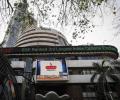
The 30-share Sensex and the 50-share Nifty ended flat at the mark of 27,403 and 8,248 respectively.

Investors may have to wait a little longer for Unified Payments Interface (UPI)-based block mechanism in the secondary market even as the market regulator has set the effective launch date as January 1, 2024. Several brokerage firms said they may take a few months more to implement it. Investors will be able to register for this facility only if the stock broker has opted for the UPI block facility.

'Waiting for a market correction and optimising entry time in the markets will be akin to missing the woods for the trees.'

Following are comments from economists at leading financial institutions, banks and rating agencies on the interim Budget:

The Budget came in a period when good news was otherwise scarce.

'The private sector will look to the budget to check whether there are any headwinds or tailwinds.'
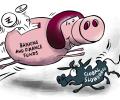
Even as banks and finance companies are reporting record-high earnings, their weighting in the benchmark National Stock Exchange Nifty50 Index has seen a downward trajectory. Investors expect a stronger performance from other sectors in the new year. Currently, banking, financial services and insurance (BFSI) companies collectively hold a weighting of 34.5 per cent, down from 36.7 per cent at the end of December 2022 and a record high of 40.6 per cent at the end of December 2019. This represents the sector's lowest weighting in the index since December 2021 when it stood at 33.7 per cent.

For development finance institution to succeed now, the government must stand like a rock behind it and be patient.

Trinamool Congress is the second highest recipient of political donations through electoral bonds.

Operating margins have been the primary driver of corporate earnings in India in recent quarters, despite revenue growth suffering from weak consumer demand. Companies across sectors have reported a sharp improvement in earnings before interest, tax, depreciation, and amortisation (Ebitda) margins over the past two years, benefiting from lower commodity and energy prices. Higher margins more than compensated for slower revenue growth, resulting in double-digit growth in net profit for five consecutive quarters.

Infrastructure funds, which bet on stocks closely linked with infrastructure development in the country, have emerged as one of the best-performing categories over the past year. They have generated an average return of 90.63 per cent - the third-best, after technology funds and small-cap funds. Of the 21 schemes in the category, seven have given a return of more than 100 per cent in a year.
Market regulator Sebi on Friday barred Anil Ambani-led Reliance Infra and RNRL from investing in secondary market till 2012, besides imposing a charge of Rs 50 crore (Rs 500 million) for settling a probe into alleged unfair market dealings by the two firms.
